Blog

Famous Footwear – “Neighborhood”

Every one in awhile, life throws you a bone.  In this case, Director Loni Peristere of Zoic Studios asked me to shoot 3 commercials with him over a little more than a week in Vancouver.   The bone? (Besides the work!)  One of those 3 – was to be shot at 600 fps – at night – with snow and with motion control!   We all knew that this one had the potential to be very special.  And I think Loni and the team nailed this one!   Here it is:

[vimeo video_id=”17355509″ width=”700″ height=”525″ title=”Yes” byline=”Yes” portrait=”Yes” autoplay=”No” loop=”No” color=”00adef”]

This was a dream job for me – for several reasons.   For one – it was a beautiful story with a simple but strong emotional thread that we can all relate to easily.  Second, Loni wanted to make this thing sing visually – and he made sure that I had the resources at hand to pull this shoot off.

First we needed 225,000 Watts of light – a MASSIVE amount – to get enough light to shoot at 600 frames per second – with the Phantom Gold HD camera.    I brought one of my favorite people up with me to Canada – Gaffer Mark Lindsay who wielded the light with ease.   Basically we had enough light to cook an egg in under 10 seconds – and a turkey in under an hour.   BUT – believe it or not – all of this light got us a whopping aperture of f 2.0 on the Cooke S4/i primes…   So Yeah…  think about that for a second:  225,000 Watts of light and you get f 2.0…!!!  Even with a 360º shutter (359º to be exact) – at 600 fps SO LITTLE LIGHT is actually making it to the sensor.

This was a huge technical challenge – and one that several people told us: “could not be done” on as large a stage/setting as we were hopping to do – with diffused lights.  Lighting it with enough light is easy – but lighting it well is not with a good quality and shape of light isn’t.

Below is a great video that shows you the behind the scenes shoot – all of the people, the gear, the lights.  A HUGE thanks goes out to Chris Dowsett for shooting this footage – and for putting this edit together for everyone to see!

[vimeo video_id=”17387884″ width=”700″ height=”525″ title=”Yes” byline=”Yes” portrait=”Yes” autoplay=”No” loop=”No” color=”00adef”]

You’ll see we used the GoPro HD camera (see bottom of that page) and mounted it on the motion control rig to get you a first person perspective – or a first camera perspective if you will.

One other hero on the shoot – was my 1st AC – or focus puller.  Cam Hayduk – with more than 26 years of experience under his belt as a 1st AC, had the impossible challenge of keeping focus with up to a 100mm (see the tight headshot of our actress with hair flowing) WHILE moving on a dolly, as she too was running towards camera.   Did I mention this was done at f 2.0> At one point we had less than an inch of depth of field.   And don’t forget – that a split second of being out of focus at 600 fps- or “buzzing” – last an even greater eternity when played back at 24 fps.  (One quarter second shot at 600fps will last 6.25 SECONDS when played back at 24fps…. that’s a long time for everyone to see you were soft on set… no pressure at all there!)    And not to belabor the point: but the dolly was being pulled/pushed by skilled human beings – not a robot.   Ergo a variance in speed in both the dolly, and the actress was expected – not to mention a ramp up an down.  Each burst lasted 7 seconds max with the RAM aboard the camera at 2048X1080…  Cam was the MVP of this shoot in my book.

The last technical challenge?   When shooting at f 2.0 – how could we get multiple planes of focus at once?  It was impossible.  We discussed tilt-shift lenses – but those would have looked quite odd with snow.  Adding twice the amount of light (cost prohibitive!) would have gotten us all of f 2.8.

Therefore we shot many of the sequences with a motion control rig.  Basically a computerized dolly/jib system – that can repeat each move EXACTLY time and time again.    You’ll notice one shot where the actor puts his foot down from the cab – and the actress is running towards him.   Getting them both in focus at 600 fps wide open would have been impossible.   Here is the magic of Motion Control + a great post house to splice them together seamlessly.

Overall – all 3 shoots were a blast.  But this one is special for me.   Not only did it turn out beautifully – but we had an absolute blast on set – as you can witness by all of the smiles in the behind the scenes video. (And we were shooting NIGHTS!!!  After 3 shoot days during daylight hours.)

Thanks to the entire crew, cast, production, art deparment, PAs and to the incredible people who did the post at Zoic – and to Loni – it was an unforgettable two winter nights in Vancouver – in July!

and if you haven’t seen enough, here’s one more:  a time lapse Chris shot of everything being set up:

[vimeo video_id=”14785537″ width=”700″ height=”525″ title=”Yes” byline=”Yes” portrait=”Yes” autoplay=”No” loop=”No” color=”00adef”]


Suddenly the past feels not so distant: Color Images from 1939-1943

Mike Evans, a welder, at the rip tracks at Proviso yard of the Chicago and Northwest Railway Company. Chicago, Illinois, April 1943. Reproduction from color slide. Photo by Jack Delano. Prints and Photographs Division, Library of Congress

Mike Evans, a welder, at the rip tracks at Proviso yard of the Chicago and Northwest Railway Company. Chicago, Illinois, April 1943. Reproduction from color slide. Photo by Jack Delano. Prints and Photographs Division, Library of Congress

It’s pretty rare that I find myself stunned by a series of photographs.

When it comes to historical photographs – I must admit that I more often than not find myself (or allow myself) to be overtaken by nostalgia.

Who doesn’t like to dream of how the “good old days” were – and how much more “simple” life was then relative to today.  Sure times may have been “tough” – but life was so relatively “simple” and “pure” relative to our technology-driven, impossibly fast-paced world of today – right?

The people we see in the average black and white historical photographs are clearly frozen in the past.  A world that I can only imagine and one that I often wish I had been able to witness.

That world (almost always photographed in black and white) is far removed from the one I see everyday.  Much of that has to do with the palette of the film and the grain structure of the film – the monotone nature making the homes, clothing, settings and faces – distant, and even at times ghostly.  I feel like I’m staring into the eyes of someone who has long ago passed away and who’s instance is captured in that single frame.

The following images were taken by the Farm Security Administration/Office of War Information during the years of 1939-1943 are quite different from those photographs.   Notably – they are in color.   Many of these images were also shot on medium to large format negatives – and as a result show a pretty incredible level of detail.

The shocking thing for me, as I look at these images taken more than 67 years ago, is how real the people appear.  Suddenly they are not so distant, not so far removed from some of the people I have photographed in my career throughout this country and the world.   These are people I can relate to much more intimately.

Women workers employed as wipers in the roundhouse having lunch in their rest room, Chicago and Northwest Railway Company. Clinton, Iowa, April 1943. Reproduction from color slide. Photo by Jack Delano. Prints and Photographs Division, Library of Congress

Women workers employed as wipers in the roundhouse having lunch in their rest room, Chicago and Northwest Railway Company. Clinton, Iowa, April 1943. Reproduction from color slide. Photo by Jack Delano. Prints and Photographs Division, Library of Congress

In fact – they seem almost too real – too modern.   Were these photos taken yesterday on the set of a major motion picture – I would commend the art director / wardrobe / makeup and stylists… and wish them well with their filming of the second season of Boardwalk Empire.

I find these images pretty incredible as they tend to erase a lot of that sense of nostalgia that I often feel as I look into the past.  These images make me realize that while times were different, while clothes and technology and the landscape were less evolved – the people then are not so different than the people we know today.  At least not as different as I thought they were.

I’ve always known myself to be a bit of a sucker for dreaming of somehow getting the chance to travel back in time and to see how people REALLY were back then – and I think that I’ve see a glimpse of that dream in these pictures, and learned that perhaps the people then,  are much closer to the people I photograph in the present – than I ever wanted to imagine.

I’ve said enough – for now I’ll let the pictures speak for themselves.

For those interested in the history of these photographs, the goal of this government funded photojournalism was to capture the state of America as it pulled itself from the Great Depression and industrialized itself in the years leading up to the Second World War.

The following photographs are property of the Library of Congress and were included in the 2006 exhibit, “Bound for Glory: America in Color”  and thanks to David Meyer @dameyer for letting me know via twitter of the following link that shares so many more of these and of many other decades on the library of Congress’ online portfolio/archive.

Switchman throwing a switch at Chicago and Northwest Railway Company's Proviso yard. Chicago, Illinois, April 1943. Reproduction from color slide. Photo by Jack Delano. Prints and Photographs Division, Library of Congress

Switchman throwing a switch at Chicago and Northwest Railway Company's Proviso yard. Chicago, Illinois, April 1943. Reproduction from color slide. Photo by Jack Delano. Prints and Photographs Division, Library of Congress

Children in the tenement district. Brockton, Massachusetts, December 1940. Reproduction from color slide. Photo by Jack Delano. Prints and Photographs Division, Library of Congress

Children in the tenement district. Brockton, Massachusetts, December 1940. Reproduction from color slide. Photo by Jack Delano. Prints and Photographs Division, Library of Congress

Worker at carbon black plant. Sunray, Texas, 1942. Reproduction from color slide. Photo by Worker at carbon black plant John Vachon. Prints and Photographs Division, Library of Congress

Worker at carbon black plant. Sunray, Texas, 1942. Reproduction from color slide. Photo by Worker at carbon black plant John Vachon. Prints and Photographs Division, Library of Congress

Shulman's market, on N at Union Street S.W. Washington, D.C., between 1941 and 1942. Reproduction from color slide. Photo by Louise Rosskam. Prints and Photographs Division, Library of Congress

Shulman's market, on N at Union Street S.W. Washington, D.C., between 1941 and 1942. Reproduction from color slide. Photo by Louise Rosskam. Prints and Photographs Division, Library of Congress

Backstage at the "girlie" show at the state fair. Rutland, Vermont, September 1941. Reproduction from color slide. Photo by Jack Delano. Prints and Photographs Division, Library of Congress

Backstage at the "girlie" show at the state fair. Rutland, Vermont, September 1941. Reproduction from color slide. Photo by Jack Delano. Prints and Photographs Division, Library of Congress

Mrs. Viola Sievers, one of the wipers at the roundhouse giving a giant "H" class locomotive a bath of live steam. Clinton, Iowa, April 1943. Reproduction from color slide. Photo by Jack Delano. Prints and Photographs Division, Library of Congress

Mrs. Viola Sievers, one of the wipers at the roundhouse giving a giant "H" class locomotive a bath of live steam. Clinton, Iowa, April 1943. Reproduction from color slide. Photo by Jack Delano. Prints and Photographs Division, Library of Congress


Fader Filters vs Traditional ND Filters

I recently had a chance to get my hands on two demo Fader Filters vs traditional ND filters and performed some comparison tests (results below)– but if you are unfamiliar with these new products, here’s a brief rundown of what they are and how they can come in handy for the HDDSLR filmmaker.

A Neutral Density Filter cuts down on the amount of light that reaches sensor (of film.)   NDs come in different standard strengths as well– 1 stop, 2 stop, all the way up to 10 stops (and beyond.)

For the filmmaker, Neutral Density Filters are an essential tool.   Still photographers have a bit more latitude to maneuver  their exposure by changing the shutter speed.  But filmmakers/videoagraphers generally leave their shutter speed fixed at 1/50th of a second.   Therefore the HDDSLR shooter needs an ND filter for pretty much any exterior scene (unless they’re shooting at night of course,) otherwise they will find themselves shooting between f/11 through f/22 in bright sunlight at ISO 100 for example.  Therefore, it is not uncommon for me to carry around 10 or more ND filters at a time for any production – big or small.  As I said:  ND filters are essential, and should probably be one of your very first purchases as you move from stills into HDDSLR video.

This is where the Fader Filters can come in handy – and really shine.  Fader filters basically allow you to have all of the filters in one.   Instead of having to purchasee separate ND filters  (for example a ND 0.3 = -1 Stop of light, and ND 0.6  = -2 stops, an ND 0.9 = -3 stops,  and ND 1.2 = -4 stops of light etc) you have the option of purchasing ONE filter that covers all of those ranges, and in fact in between.   The Fader filers work much like traditional circular polarizers: in the flick of a wrist, you can cut out as much as 8 stops of light. This will come in really handy in documentary or on-location situations when you might not have the opportunity, or the time to unscrew the filter you already have on your lens, go searching through your camera bag for the right ND filter, and screw that into place. By then, the moment may be lost.

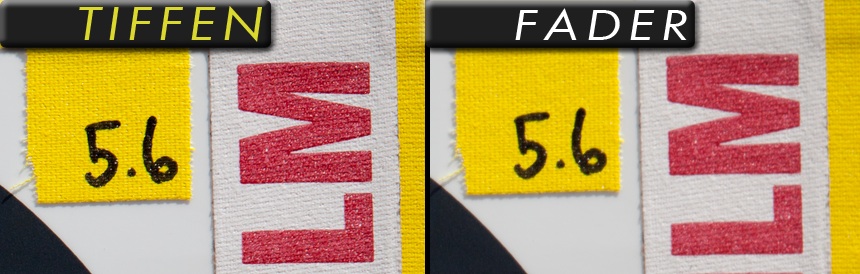
Now for the test results:  below are some results between the Fader filters and TIFFEN ND filters. (click on th image to see the full resolution images.)

I tested the Fader HD Variable Neutral Density Filter line, specifically a 77mm Fader on an EF 70-200mm f/2.8L IS II USM on a Canon 5D MK II at Full Raw + Large JPEG, set to an f/5.6 and remotely triggered with a set of pocket wizards to minimize any camera shake.   (You can use the 77mm Fader on most of the Canon Zooms,  you will end up using the 82mm Fader on the Canon 16~35mm Version II, and the 72mm Fader for many of the Canon prime lenses.)

All in all, the Faders performed quite well. The ND range is extremely versatile and useful for the HDDSLR filmmaker. The main advantage of using the Fader is its ease of use, and critical time-saving benefits. I don’t see hardcore photographers and photojournalists reaching for the Fader any time soon as you can see when compared with a Tiffen ND 0.6, the sharpness quality is not as good:

That being said,  don’t let the loss in sharpness scare you off.   While some photographers might not find the sharpness up to snuff – HDDSLR shooters might find these filters do the job just fine.  When you take into account the downsampling that takes places with HDDSLRs and the H.264 compression the loss in sharpness is hardly noticeable– and in some situations (mainly when encountering our favorite Canon moiré issues) the slight loss in sharpness comes in handy.

The only other downside that  I noticed with this set of filters, is that I found it difficult (if not impossible on some lenses) to get the traditional Canon EF lens hood to attach as the Faders have a bit of a lip to them (to allow for the rotation of the optical elements within.)

Any documentary filmmaker, wedding shooter, or independent filmmaker looking for a big time saver with a big boost in efficiency and a shallower depth of field in their video, you may want to give these Fader Filters a try.