Blog

3 Years later… “Mobius” and the Canon C300 / C300PL

HDSLRs were born a little over 3 years ago – and my life and that of many others has forever been changed as a result.  

What an incredible time  it’s been for many of us!   And that is about to change again today…

The number "3" seems to have an unusual relevance to this short film "Mobius":  

I was asked 3 months ago to shoot a short film for Canon to highlight the new Canon C300 camera.

We wrapped our 3rd day of shooting on what turned out to be exactly the 3-year-anniversary of the release of "Reverie."  (I received a tweet about it that night which was a cool surprise and made me pause for a few seconds on set – what a strange coincidence right?! )

Canon is making this "historic" announcement on November 3rd.

This is the 3rd prototype camera Canon has asked me to test (Reverie / Nocturne / Mobius)

We used 3 C300 bodies for the shoot.   And this post is 4 posts shy of the 300th post on this blog.

And finally 3 is the natural successor to the Canon 5D MKII …

*UPDATE: Oddly enough (and before this post was published) I was seated at table #3 at the Canon dinner on the evening of the premiere (out of more than 40 tables…)

Without further ado – here is the short we produced with a wonderful cast and crew (more to come on them in the upcoming days) –

Mobius – 720p Version from Vincent Laforet on Vimeo.

Note that this version is optimized for fast playback on the majority of systems – it does not show the optimum image quality in terms of resolution and compression.  To get the highest quality image go to the 1080p link below.

Here is a LINK to the 1080p version of "Mobius" for those of you who’s system can handle it.   

A downloadable version of the final film (5GB) will be made available shortly courtesy of Apple and iTunes.

Follow me on Twiiter @vincentlaforet for breaking updates on this and other events!

 First a behind the scenes look:

A special thank you goes to the Vimeo team for shooting and editing this piece – not to mention joining us on set!   Big thanks to Blake Whitman and Sam Morrill.

SPECS: For those of you who are dying for the specs here they are – with my commentary in italic:

Sensor:  New Canon 8.29 Megapixel Super 35mm Cinema CMOS Sensor – 3840 x 2160 effective pixels

Native 1920×1080 capture with 3 separate 2.0 megapixel color channels – 2.0mp G, 2.0mp R, 2.0mp B) without the type of interpolation required by most cameras in this price range.

Ergo this is in effect a 4K sensor creating a 1080p image.  This results in what I would say is easily one of the best digital cinema sensors on the market  – at least that I have worked with (I have worked with all of the digital cinema cameras released within the past 2-3 years.*)   The camera’s only competition right now are the Arri Alexa and Red Epic – although each of the 3 sensors and cameras have distinct advantages over one another  – there is no perfect camera.  

The Canon C300 produces an INCREDIBLY sharp image at 1080p on a 60 foot screen.   There is ZERO aliasing or moire – goodbye forever!!!

It should be said:  DSLRs are FAR FROM DEAD.   Their price point, size, and accessibility to the "masses"  will allow them to thrive for years to come in my opinion.  The above mentioned cameras are in a different price league.   I have not heard of an official price yet from Canon, but it is safe to say that the price will be north of the Canon 1Dx.

*(I haven’t tried the Sony F65 and I haven’t been able to test the new Phantom Flex – the Phantom Gold’s sensor is quite impressive.)

Read the rest of this entry »


“Mobius” / C300 Post will go live at 5:35PM PST

Check back in one hour – I will be posting my short film, "Mobius" shot on the new Canon C300, along with a BTS and my thoughts on the camera specs. 


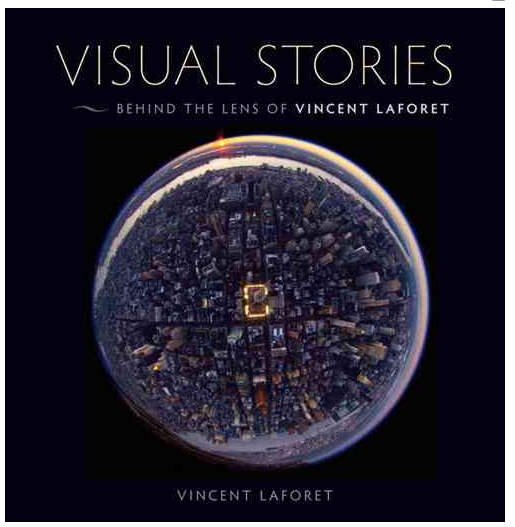
My First Solo Book: VISUAL STORIES

I’m proud to announce my first solo book: VISUAL STORIES.

The book is available now for pre-order and comes in both eBook and as a printed book of course,  and will hit the shelves on November 14th.  

I’ve been a included in more than two dozen books over the years – but this is the first one that focuses on my photography.

VISUAL STORIES is effectively a look back through 18 years of my work as a photographer for The New York Times, Time, Life, Newsweek, National Geographic amongst others, as well as commercial, aerial, sports, and fine art photography.   I didn’t want to write too technical of a book – so I decided to focus more on the stories behind the images, the thought process and often the psychology involved in making the photographs.     I talk as much about the "why" as I do about the "how" if you will.  

I wanted to write a book that included the details that I loved to read when reading other photographers’ books.   I found that while I loved to know what lens they’d used to make some of my favorite photographs, I was more fascinated with how they got to making that photograph, the thought process and stories behind them (or luck) and what they thought of those photographs after the fact.  Those stories always fascinated me most.   

What I’m most excited about is that a few people who are NOT photography enthusiasts have told me that they really enjoyed reading it.    

So if you’d like to know what it felt like (and what went on in my mind) when I shot from the needle of the Empire State Building,  or made photographs of The Super Bowl, landscapes and aerials all the way to covering the Olympics and the aftermath of hurricane Katrina – you just might enjoy this book.   I do address technical details of course and the metadata is included under each image.   There is also a DVD included with more than 2 hours of video of me discussion many of the images beyond what you’ll read in the book.

Below are a few excerpts from the book that spans 264 pages and includes more than 100 images.  Both are available for pre-order now.

Here is a link to the hard copy: Visual Stories: Behind the Lens with Vincent Laforet  (HARD COPY)

And a link to the eBook version: Visual Stories: Behind the Lens with Vincent Laforet (eBOOK)

Lastly, here are two excerpts from the book:

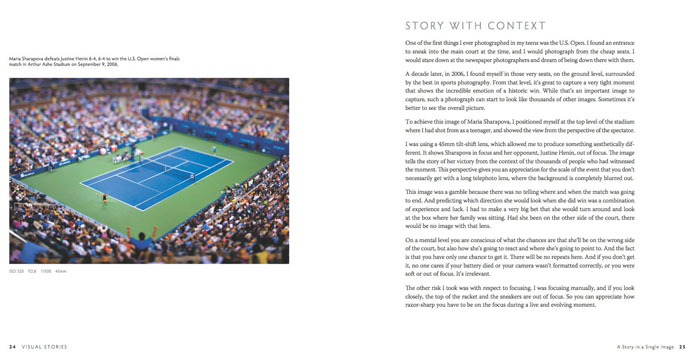
"One of the first things I ever photographed in my teens was the U.S. Open. I found an entrance to sneak into the main court at the time, and I would photograph from the cheap seats. I would stare down at the newspaper photographers and dream of being down there with them.

A decade later, in 2006, I found myself in those very seats, on the ground level, surrounded by the best in sports photography. From that level, it’s great to capture a very tight moment that shows the incredible emotion of a historic win. While that’s an important image to capture, such a photograph can start to look like thousands of other images. Sometimes it’s better to see the overall picture.

To achieve this image of Maria Sharapova, I positioned myself at the top level of the stadium where I had shot from as a teenager, and showed the view from the perspective of the spectator.

I was using a 45mm tilt-shift lens, which allowed me to produce something aesthetically different. It shows Sharapova in focus and her opponent, Justine Henin, out of focus. The image tells the story of her victory from the context of the thousands of people who had witnessed the moment. This perspective gives you an appreciation for the scale of the event that you don’t necessarily get with a long telephoto lens, where the background is completely blurred out.

This image was a gamble because there was no telling where and when the match was going to end. And predicting which direction she would look when she did win was a combination of experience and luck. I had to make a very big bet that she would turn around and look at the box where her family was sitting. Had she been on the other side of the court, there would be no image with that lens.

On a mental level you are conscious of what the chances are that she’ll be on the wrong side of the court, but also how she’s going to react and where she’s likely going to look towards.  And the fact is that you have only one chance to get it. There will be no repeats here. And if you don’t get it, no one cares what the reason was –  if your battery died or your card wasn’t set or formatted correctly, or you were soft or out of focus. It’s irrelevant.

The other risk I took was with respect to focusing. I was focusing manually, and if you look closely, the top of the racket and the sneakers are out of focus. So you can appreciate how razor-sharp you have to be on the focus during a live and evolving moment. 

Despite those challenges, the photograph conveys the story of how Sharapova at this particular moment is at the center of the world, especially at the center of the tennis world, and that Henin is completely irrelevant and out of focus. The front page goes to the winner. The one who loses either never makes the paper or gets buried in history." 

Click below for another example – Read the rest of this entry »