I just completed an HDDSLR project that involved shooting stills and video at several locations across the U.S. The shoot was commissioned by Greg Sylvester of VSA Partners a well known agency that has a wide range of corporate and commercial clients. Our goal was to produce an annual report that would live both in print and digitally on the web as both stills and video segments. While this was by no means a “small shoot” it still lives in the mid-level sized corporate shoot in my book - this is no means what I would bring to an editorial shoot for example.
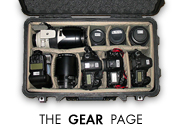
Given the level of interest in this new technology - I though that readers might appreciate a slide show of images that show what such a production might entail in terms of gear. Please note that over the next few weeks I will be going over the gear that I used in this production on this blog in detail - so please hold all of your gear questions for now.
I can image some of the reactions to seeing (or trying to find) a Canon HDDSLR buried under all of this gear. ”Why in the world would one go through this?” - someone might ask. Why not get “x” camera. Well the long and short of it: the LOOK of these cameras is incredibly unique - the video coming out of these camera looks incredibly close to 35mm motion picture film (see image 13 in the slideshow for a good example of what separates this breed of cameras from the others.) Pulling off a similar production with a 35mm film of system would be significantly more time consuming and expensive - there is absolutely zero doubt about it. And don’t forget: the way these cameras perform in low light - also separates them from the competition. So there absolutely is reason behind all of this madness. I had to mention this because I sometimes catch myself asking the very same question… and then I see the results on screen and all doubt is removed. (more…)
First that Apple was going to release an iPad/iSlate.
My second prediction is that 2010 would be the year of the HDDSLRs - one in which finding their full potential with the help of other partners would lead to incredible developments.
2010 will indeed be seen as the coming of age of HDDSLRs.
Today Zeiss showed the very first “Compact Prime 2″ Cine Lenses that will mount on HDDSLRs. In fact these are quite versatile in that they come ready to accept both and EL (Canon mount) and PL (Cinema standard) that can be switched on the field w a Tor-X screwdrivers. (Although Zeiss recommends you have them do this.)
I’ve had chance to get my hands on this series and I immediately fell for them - I have also been promised a chance to test them out soon -I’ll be sure to share the test with you on this blog within the next few weeks.
The optical quality is excellent. More empirical test coming on that soon. But the main reason pros and advanced filmmakers will flock to this series relate to the ergonomics and practicaliy of using this lens on a just about any production. You will find that the optics have been re organized in this lens - but that it will perform very similarly to your ZE set. The main difference is that only the very best optics are chosen for this series vs the ZE lenses. The second key point is that the aperture blades comprise of 14 blades vs the ZE series with 9 - therefore you can expect a much more beautiful focus falloff..
At this point they are releasing a set of 8 Compact Primes at NAB 2010 and making them available for sale in May. A set of 6 will retail for less than $20,000. You can of course buy lenses independently at a higher price. Zeiss will be making the announcement as to which specific series of lenses they are releasing.
So what’s the big deal? Well for once this is the first series of PL lenses that Zeiss has produced in history that covers the full 24mX36mm sensor - EVER…
All others covered he Super35mm format… This is therefore a good long term investment it seems. This should also put an immediate halt to people removing their mirrors and drilling into their mirror boxes to use these lenses.
Lastly - this is the first lens that I’ve received - that I CANNOT WAIT TO USE!
Why? My 1st AC/Focus Pullers will love me. When the lens it says it’s focused a .38 meters - guess what - it is!
Set your marks - and if you and your actor hit their makes - you’re tack sharp.
MPEG Streamclip for Mac or Windows is a CHAMP at converting the H.264 footage! And it's FREE.
One of the most common questions that I get from people regarding the new breed of HD-DSLR cameras is “What’s your post-workflow?”
Truth be told - most of it is actually extremely straightforward. It does get fancy when you try to do some high end stuff- but that workflow applies to maybe one percent of people - so here is the simple workflow:
Simply put - all you need to do is to convert the native footage from the Canon 5D / 7D / 1D MKIV from the AVC H.264 format to a format that your computer and software will support.
For me it’s simple given that I work with Final Cut Studio - I work with Apple’s ProRes codec. What this means is that I simply convert the H.264 footage to the higher quality (and less compressed) ProRes format. (Avid supposedly supports the H.264 format natively according to some post houses that I’ve worked with - but I admit to not being an Avid or Adobe Premier expert by any means.)(more…)
Tuesday October 20th 2009, 6:19 pm
Filed under: Articles, Hardware
Canon has requested that we take down “Nocturne.” As a professional courtesy I am going to honor their request until they can figure out things internally and our little film can be shown again in public. As some of you may remember this happened last year and all was fine a few days later. I’m sure they will be able to figure things out on their end and hope to be able to share the short with you again soon. The response so far has exceed that of “Reverie” both in terms of numbers and in terms of how fast it happened - something that I would never have expected.
Tuesday October 20th 2009, 2:32 pm
Filed under: Articles, Hardware
David Nelson and I - late late Saturday - or I guess that makes it Sunday - Morning. As a technical reference - this is a frame grab from a 5D MKII. The light was SO yellow we se the 1D MKIV to 2500K... and it was still yellow.
First of all - thank you for all of the positive comments (and a few of the nasty ones too!)
I wanted to clarify a few things - because I won’t have time to answer all of the e-mails / blog posts - many of which are asking the same questions.
First - I really want to give due credit to Stu Maschwitz & David Nelson - my co-filmmakers. We agreed to work together (having more than one director is never a good idea - we all knew it - but we were too swamped with our day jobs to pull this off alone under such short notice) but things worked out for the best in the end.
Collaboration is a wonderful thing. This film would not have been what it is without them. I also want to thank Michele the producer - as well as everyone on the cast and crew. Some of you may be rolling your eyes - but until you’re on this side of things, you may not appreciate just how much of a team effort filmmaking is. The film is only as good as its weakest link - and we didn’t have a single weak link on this cast or crew - no matter how late in the morning it was.
Almost everyone had a day job to go back to after each night - often on other productions that lasted more than 10-12 hours… Ben Nussbaum and his post house Pictures in a Row were exceptional. Ben worked 5-6 days straight on this - day and night working in between his own projects. He owns a huge part of the creative puzzle that made up this film. (more…)
UPDATE: CANON HAS REQUESTED THAT THE VIDEO BE TAKEN DOWN FOR NOW. PLEASE SEE THE MOST RECENT POST.
In 2008 we witnessed the birth of HD-DSLR Cameras.
In 2009 you will be introduced to cameras that can see in the dark better than the naked eye.
Just a little over a year ago my jaw dropped when I stumbled upon the 5D MKII and saw 1080p video coming off of a full frame chip for the first time.
Just a little over two weeks ago my jaw dropped even harder when I took a prototype of the Canon 1D MKIV outdoors to test it at night. I was on the road, it was late and I had just rushed back to my hotel to get to the unit. I was expecting a 1D body, with 24p, a 1.3 crop factor sensor, 10 fps for stills, a new AF system - 60 fps at 720p - and of course 1080p video.
Nothing prepared me for what happened next.
I set the ASA to high - and I pointed it towards an area lit by a single flood light. The image was overexposed by 4-5 stops. I then started to play with the settings, pointing my light into an area in complete shadow (my eye saw nothing but black) but on the rear of the LCD I saw sharp, green leaves as crystal clear as if it were shot in daylight.
I think it’s safe to say that every single filmmaker and photographer has always dreamed of cameras that can see what our naked eyes can see. This time these cameras can actually see more. Sure - they may not have the dynamic ranges of our eyes just yet - but they see more than my naked eyes can see in low light.
Period.
And that’s qualifies as a paradigm shift in my book.
The next few years will see photography and filmmaking redefined by technology. While there is no substitute for exquisite lighting - artists will now be able to explore areas once thought impossible to photograph.
Think of all of the images you’ve missed throughout your career. Think of all of the places you didn’t even consider going to film - because they were too dark. Those days are now but a distant memory. Even if you don’t need to go into the shadows - imaging photographing at f 5.6 or at f 8 at some point soon in areas you are struggling to capture at 1/50th, f 2.8 at 1600 ASA currently…
In many ways these past two weeks felt like Reverie all over again. I had not expected to get the 1D MKIV until after the Photo Plus Expo. When I got a voicemail letting me know in a very unceremonious way that two units were waiting for me to try ”we need your shipping address” the message said - I was surprised. Canon did not have any plans to have me or anyone shoot anything this year in time for the announcement.
When I saw what this camera did at night, I pushed the all hands on deck button - calling my friends and colleagues to engage in an “interesting project” that I could not elaborate on. They pretty much had to trust me that it might be worth their time and commit to it blind.
Once again - we had very very little time to prepare. Just under 72 hours. And we were ALL busy working on other jobs as this economy seems to be awakening again.
What you will see below - is what we were able to pull together under a pretty ridiculous deadline. Once again there were no film permits (no time… no time to location scout and apply) no fancy anything. But I did have some incredibly talented people out here in LA willing to help on such short notice - we shot over two nights in downtown Los Angeles. Most of the cast and crew had worked a 10-12 hour day shift. We all worked close to 48 hours straight last weekend. Everyone was bitten by the bug if you will - once they saw what this camera could do. I was incredibly fortunate to work with one of the best group of people out there -period.
Here is the main point that I hope you take into account: the short film you are about to watch was shot in pretty much the very worst light that I could possibly find in an evening urban landscape. I did not chose “pretty lighting” in a mall or under neon signs. That would have been cheating in my book.
The short was shot near East 6th and Mateo St. in Los Angeles - in an industrial part of the city. If you live in the area - go check out the area - you won’t believe the video you see below came from the poor lighting in that area. Sodium and mercury vapor lights. That’s it. Really awful lighting.
Not a single external light source was used / added. In other words I did not use a single flashlight, LightPanel, flood light - nothing. For one shot only I pulled out a silver reflector… just to say we did it really. And yes it worked (see the shot of the young girl.)
The ISO stayed locked in the 6400 ASA range - with a very few shots hovering 1 stop above and one or two set to 3200 ASA because we had TOO MUCH depth of field…(on the bridge.) At one point I found myself shooting at 12,800 ASA by mistake - and I didn’t even notice any noise on the rear LCD in the skies… 6400 ASA is the new 1600 ASA - maybe even the new 800 ASA. Stop to ponder that for a second - and what it can mean to the way you approach your craft.
In the upcoming days I will share more details, behind the scenes, post workflow etc. A huge thanks goes out to my co-directors Stu Maschwitz, David Nelson and our incredibly resourceful Uber Producer Michele Abbott - and every single member of the cast and crew. For now - if you even made it this far - take a look into the shadows:
CANON HAS REQUESTED THAT THE VIDEO BE TAKEN DOWN FOR NOW. PLEASE SEE THE MOST RECENT POST.
P.S. Before the end of the year - I plan to release a series of downloadable videos - that cover numerous production tips/aspects of these HD-DSLR cameras - as well as post workflow. Basically everything I know. If you are interested - pls send an e-mail to production@vincentlaforet.com - with the word “NOTIFY” in the subject only. I will then contact you when those are available. No obligation on your part of course - just send me an e-mail if you’d like to be notified. We are already in pre-production for the series.
P.P.S. - on a technical note: because I know everyone will ask: the footage was graded with Stu’s Magic Bullet Colorista software (PLEASE CHECK OUT STU’S BLOG POSTING ON THIS SHOOT HERE) that he helped design and treated for noise (not a significant amount at all to be honest - at some point I may put up raw clips.) The point here is to show what this footage CAN look like when processed on an average laptop (i.e. nothing fancy!)
The 1080p footage on SmugMug is pretty incredible - but remember that a 365 MB compressed file was initially uploaded and then re-compressed a second time - from a 2.32 GB original uncompressed file. You can expect that the blacks will be a bit clamped, and that there will be a loss in sharpness relative to the original.
Monday October 19th 2009, 12:55 pm
Filed under: Gadgets, Hardware
It’s been awhile since I’ve updated my gear list on this blog to reflect some of the new toys that I’ve put into the mix of my HD-DSLR kit.
I’d like to share three pieces that I think might be relevant to many out there.
First I’ve been using a new rig quite a bit that Bruce Dorn makes -it’s called the IDC U-Boat Commander Rig for HD-DSLR Video. I’ve had it since January and I’ve found myself using it more and more.
As you may know - I’m a big fan of the RedRock Micro DSLR Rig - and I tend to use that when I need to mount a Marshall Monitor, the 5D MKII or 7D together on a rig such as a set of sticks, dolly, jib or Steadicam. However for some - I can see others needing a slightly more compact rig. One can of course customize the RedRock Micro rig down to be pretty compact - but I have to say that both of these solutions are quite elegant.
Bruce Dorn’s design is economical, sturdy, and quite elegant - so much so that he’s sold quite a few to the US Military’s combat photography unit - and that’s a stamp of approval if I’ve ever heard of one.
His rigs come in two flavors - the U-Boat Commander which is perfect for attaching a external mic to, and the even smaller iDC Run & Gun Kit / Follow-Focus & Viewfinder Kit - which is easily the single most understated way of intelligently building up your 5D MKII without making it too intimidating / apparent to others. (more…)
One of the most important accessories that you can purchase to help you get better results with the video from your Canon 5D MKII is an external LCD monitor (a video assist monitor.)
The Canon 5D MKII was designed as a still camera first, therefore when you shoot video you will often find that the placement of the LCD screen, not to mention the ergonomics of the camera body itself are not ideally suited to shooting video. Being able to hold the camera below your eye-line (or any angle for that matter) become quite important when shooting video vs stills.
I’ve had a chance to play with a variety of monitors out there - and for now Marshall Electronics’ V-LCD70P-HDMI is the clear standout both for the quality of the image it displays, as well as all of the extra features it offers. This is a 7″ lightweight monitor that comes in at just over a pound, and offers an 800X480 resolution image. I was able to work with a prototype of this monitor in January for 3 weeks of the Jamie O’Brien shoot and it was simply fantastic. I should also mention that I am also testing out Ikan’s V5600 5.6″ TFT LCD Monitor and will write about that at some point as well - it’s small size may be very attractive to some. (I’ve yet to put it through it’s paces, but I plan to do so in the upcoming weeks.) (more…)
(Due to the length and size of this piece I am putting it up at 720p.)
Please note that Tiffen and Formatt BOTH make screw on filters and 4 X 5.65 filters for the matteboxes. I use a variety of filters from both companies - I use 1-6 stop Neutral Density filters as well as a few 10 stop screw on filters. (The RED One camera became part of our production a few days before we left and we had to scramble to find the appropriate filters in time - luckily both Tiffen and Formatt helped save the day in last minute fashion.)
Both companies also make graduated NDs and Hot Mirror filters that cut out infra red light when using the RED One camera. The 4 stop and 6 stop are the NDs we’re using most often. I personally like the 10 stop to use my 1.2 lenses wide open in sunlight. Also - if you want to stay very light and mobile - I recommend you use the screw on filters - I travel with a set of 72mm and 77mm filters for my Canon lenses - but you could also buy a step-down adapter to screw on your 77mm filters onto your 72mm if you’re looking to economize. I tell every friend buying a 5D MKII to: 1. buy ND filters right away and 2. an good video head (see the Gitzo G2180 below) 3. an extra battery for the 5D MKII 4. and look into audio (see previous posts for the Rode mic and other options.)
We’ve also been using a variety of Manfrotto Tripods and video heads that we mention in this Behind The Scenes on this project that have allowed us to pull of some very nice pans of Jamie surfing. I can’t overstate how important it is for you to get a good tripod set to shoot nice pans - and you’ll need the heavy duty stuff to shoot with the heavier RED and long Canon glass. If you want a simple setup to start off with a 5D MKII and shorter lenses - we’ve found the Gitzo carbon fiber tripods and the Gitzo G2180 Fluid head to perform quite remarkably (but don’t overload it or any fluid head with weight - unlike still photography you can’t really get away with overloading a head with video as your pans and tilts will suffer.) Another really nice option are these self-standing monopods by Manfrotto that I recommend you use with a quick release plate.
Check out the RedRock Micro DSLR Rig and long lens support that I’ve mentioned in the past as well as the Wicked Circuits EF Lens adapter for the RED One Camera.
I will be posting a DETAILED list of all of the gear described within this and the first behind the scenes clip in a few days after we put up the 3rd installment of the Behind the Scenes up (it’s a long list and I want to add links so it’ll take me a better part of a day to do and we’ve only got a few days of shooting left on this project.)
Here is the first installment of our behind the scenes footage. I will be detailing every piece of gear used as we go through this production - and tomorrow I will post the model numbers etc. of what we are using as I’m sure a few of you might be interested in those specifics. I was planning on doing that in this post - but it’s late and we’re a little behind given the 18-hour island-wide power failure, so stay tuned.
Recent Comments