
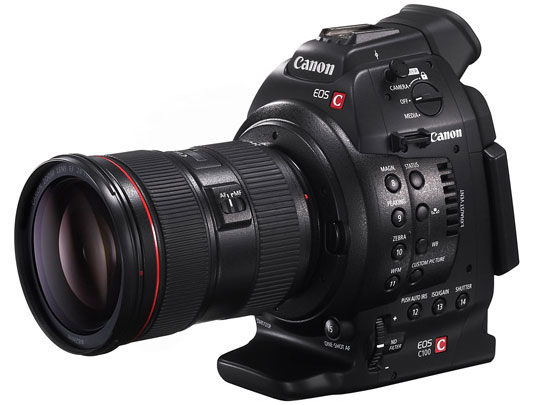
 Canon just announced the EOS C100 today – the little brother to the C300 if you will – and it is scheduled to be available in November.
I think this camera will likely put a noticeable dent in the use of mid- to upper- range HDSLRs for video production such as the Canon 5D MKIII and Canon EOS 1DX given that the C100 meets a lot of the ergonomic needs of filmmakers that HDSLRS lack (EVF, LCD, Built in ND) and a superb sensor behind it that generates an extremely sharp, wide dynamic range, and low noise image at high ISOs, off of a super-35 size 16:9 sensor.
We now have 3 Canon "C" bodies to choose from and here’s a basic recap of where each camera stands:
At the top of the food chain is the Canon C500 – 12 bit, 4K, 4:4:4 MXF Codec or Full RAW up to 60p (via external recorder) EF and PL versions, HDMI and HDSDI (x2) out, Canon Log Gamma, Records to dual CF Cards or external recorder – $30,000 (Now scheduled for an October release.)
In the Middle the Canon C300 – 2K 50 Mbps MXF 4:2:2: Codec format up to 30p (from the same sensor above) EF and PL Versions, HDMI and HDSDI out, Canon Log Gamma, Records to dual CF Cards – $15,999
And now the Canon EOS C100 – 1080p 24Mbps up to 30p AVCHD MPEG-4 AVC/H.264 codec, 4:2:0, 15% smaller than the C300, EF mount version only, locking HDMI out, Canon Log Gamma, Records to dual SD Cards – can also output uncompressed digital HD to an external recorder… $7,999 (Note: some sites are already listing the price at under $6,700.)
Now the last line of the press release should garner your attention: the ability to output uncompressed footage to an external recorder is VERY interesting.
 I really want to see how the footage looks when compressed in the H.264 format relative to HDSLRs (the image will definitely be sharper, have a much wider dynamic range – but how aggressive will the compression be?) – let alone how the uncompressed footage looks through an external recorder. The math is clear: this camera will be outputting a 24 Mbps image vs the C300’s 50 Mbps – but how will it LOOK? (For a frame of reference these are MegaBITS per second – the RED Epic outputs 50 MegaBYTES per second as a frame of reference.)
This could be quite exciting for a lot of people who are looking to move up from HDSLRs but want to stay below the all important $10K price barrier. Remember this camera comes ready to shoot (ergonomically) and has built in NDs (means: no need for rods, matte boxes, ND filers unless you want to have them) and has a built in EVF and LCD… as well as XLR inputs and stereo output jack. The C100 also can record up to 5 hours and 55 minutes continuously on a 64GB SD Card – which means an end to the 12 minute and 30 minute clip limitations of HDSLRs.
 Lack of genlock, HD-SDI, PL version etc – well I think we can expect that for the little brother… lack of RAW? I think that RAW remains with the big boys in the $10K+ range for now given the processing power a camera needs to process a 1080p+ Super 35mm sensor size image (of course there’s the Black Magic Camera available for $3K now – but with a much smaller sensor with a 2x+ crop factor relative to the full frame 35mm sensor size. I’ve had a chance to play with this camera and am looking to post something on it shortly.)
If this camera is available in the $6-7K range on the street one day – it could really question the need to shoot on HDSLRs anymore (that is for those buying the 5DMKIII or 1DX – as those cameras invariably lead to the purchase of EVFs, LCDs, Cages, Matte Boxes, and NDs…. That doesn’t of course mean the end of HDSLRs for those of course who (like most people) are trying to look for a more affordable entry point such as the 60D, 7D or Rebel of course. But for Indie filmmakers or productions – HDSLRs are now perhaps going to seem a lot less attractive.
Many may be taken aback with the idea of spending $7,999 on this camera at first. But if you stop to think about what you won’t NEED to buy – it can actually start to look like the C100 might just be a wiser investment long term. This camera comes ready to shoot. The ergonomics are great so you don’t HAVE to have a cage. You don’t need to buy an external audio recorder and synching software – this has XLR inputs (and stereo headphone jack as well as levels) with the handle. You don’t necessarily need rods, a matte box, and Neutral density filters – ND filters are built in. That alone is a savings of $1,000-$4,000 in that type of setup alone (but you can of course choose to buy a good variable ND filter for a few hundred dollars as opposed to rods and matte boxes and rod support.) You don’t need to buy and EVF and a way to mount it to your HDSLR. Same goes for an LCD – although both the Canon LCD and EVF leave a lot to be desired when compared to the Zacuto EVF and external Marshall monitors. All those accessories will still help those that want the best quality and versatility.
Given that this is the same super-35mm sensor found in the C300 – you can expect an incredibly sharp image, and incredibly good low light performance, and wide dynamic range relative to HDSLRs.
I think it’s safe to reserve judgement on where exactly this camera will stand in the overall marketplace until we can do some tests with the H.264 code and with the uncompressed signal to an external deck – but it should be a contender. I wish they had kept with the MXF format – but given the popularity of the HDSLRs over the past 4 years – all workflows and popular editing software (NLEs such as Adobe’s Premiere, Apple’s FCP X, and Avid) have come to fully support H.264 workflows.
On a personal note: I feel just a small tinge of sadness that comes with this announcement. As you know my history is deeply tied to the Canon 5D MKII and HDSLRs – and I feel like that chapter in camera history of the 5D MKII/III being used for video production, when a camera like the C100 is available, might just be coming to a close. The Canon 5D MKII will always hold a very special place in my heart of course!
Canon also announced two cinema primes in EF mounts – a 14mm T3.1 and 135mm T2.2 bringing the total number of cine primes built for 4K shooting to 5. They have also announced two lightweight cine zooms the CN-E15.5–47mm T2.8 L S/SP and CN-E30–105mm T2.8 L S/SP.


More to come…