
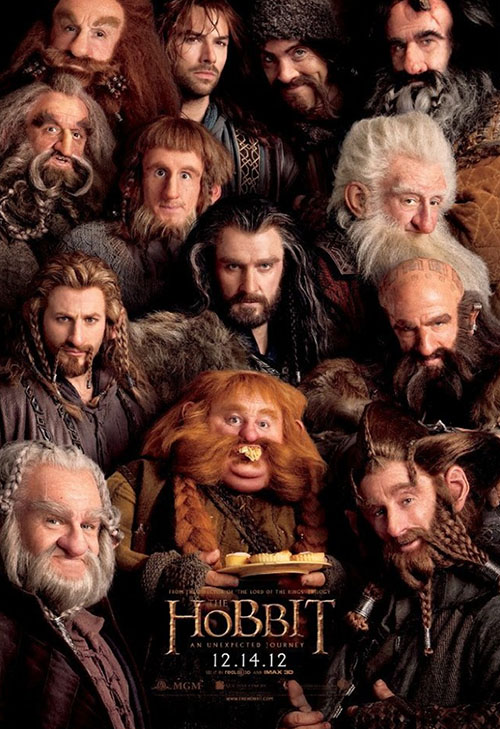
 Peter Jackson, a terrifically talented film maker and pioneer of new cinema technology, has given the world of cinema a very important, and perhaps unintended, gift with his latest film "The Hobbit: An Unexpected Journey", as we wrap the year 2012.
Tonight I went to see his latest film in all three flavors of its release: 3D HFR, Standard 3D, and in 2D.
On one end of the spectrum I had one of the most disappointing cinematic experiences in recent memory, and on the other extreme I fell into the film and enjoyed it very much – all watching the EXACT same film mind you…
I recommend any filmmaker out there try doing this – as it will reaffirm so many of the things that make film "magical" and ultimately what differentiates the medium from all other forms of entertainment and visual media. For some, HFR will be a potential new tool in their arsenal for telling certain types of stories in a new and exciting way, while others will be reminded of why the 2D format at 24 fps has stood the test of time for so long.
With his latest film, Jackson shot the film not only in 3D, but also at twice the normal frame rate or "HFR" which stands for High Frame Rate – in an effort to make the film feel more "immersive" in his own words. Ironically – I think this new technology accomplished just the opposite for me, in terms of becoming immersed in the narrative and connecting with the actors on many levels.
In my opinion, film is not necessarily about WHAT you see – but it’s almost more an exercise in what you DON’T or CAN’T see. The best Directors and DPs show you only what is relevant to the story and never introduce a random shot or character if they can at all avoid it. I’ve always preached that a director or photographer should INCLUDE elements in a frame or shots that add to the story, and EXCLUDE elements or shots that detract from it.
The reason the standard film projection rate of 24 frames per second works so well, is that it’s just a few frames faster than what the brain needs in order to be tricked into seeing what are effectively still images, appear to move on screen – it’s called the "Persistence of Vision Theory." In tandem with that important theory, the motion blur you get by shooting at 24 fps and (on a standard 180 degree shutter) at 1/48th of a second, is just as important in making something look "cinematic" as the lack of depth of field we get by using larger sensors, and bright lenses at large apertures. This is precisely why one should shoot at 1/50th of a second on their HDSLRs and use ND or neutral density filters to makes sure they don’t have too much depth of field and can also ensure they aren’t forced into shooting at higher shutter speeds.
In the past few years we’ve been pushing the technology envelope pretty hard – trying to get higher frame rates, greater resolution, more dynamic range, more bit depth, more throughput/bit rates and RAW.
Yet for some reason, many top cinematographers and even directors out there still prefer shooting in 2K or 4K/5K… And why is that?
Well I’ll try to address that in a bit, but first an anecdote:
In the opening hour of The Hobbit shown in 3D HFR – I don’t recall hearing a single sigh, or laugh. Not one. When I went to see the exact same seen with an audience of the same size on a 2D projection – I heard regular chuckles and laughter… why? Again more on that in a bit – but this was palpable and very interesting for me to witness. All of the jokes seemed to be falling flat or being missed in the HFR projection.
First – let me discuss the 3D HFR projection. For those of you who don’t know, Peter Jackson shot the Hobbit with dual RED Epic cameras on a 3D rig – and he chose to shoot it at 48 frames per second (twice the normal rate) in an effort to render a sharper, more "realistic" image if you will, notably when motion is involved. With 48fps comes a new shutter of 1/96th of second if shot at the traditional 180 degree shutter – or an image with an image that has half the amount of motion blur relative to shooting at 1/48th at 24 fps and of course twice as many frames projected every second. You can read more about this process here and another great article on FXGuide here. With the Hobbit Jackson shot at 1/64th of a second on a 270 degree shutter to split the difference if you will and get a bit more motion blur (and light.)
Many of you are likely aware that when a motion picture camera pans or moves too quickly – it can be painful for the audience’s eyes. In fact on a 30-50 foot screen it can be impossible to see a sharp image or for the audience to lock onto something with their eyes if the movement is too fast. This is something filmmakers and experienced DPs keep a very close eye on – in fact there are tables that show how fast a camera can move given any given lens before this blur happens.
Therefore Peter Jackson decided to shoot the Hobbit in 48 fps to try to counter this effect, and to render a more realistic or what he deems "immersive" 3D experience if you will.
And he has indeed accomplished that – but in doing so, he’s killed a lot of the magic of what makes a film entrance an audience if you will, at least in my opinion. I did find myself become more "immersed" in the 3 dimensional environment and all of these details – but to the detriment of the film and the narrative itself.
I should say there are indeed a lot of fans of this out there… I’m just not one of them. The opening numbers for the movies this past weekend are record breaking – but I don’t think that speaks to HFR at all. These are fans of one of the most anticipated releases and extremely successful film franchises that would have gone no matter the format it was shot in.
Now before I go ahead and criticize 3D HFR – keep in mind that almost all of these harsh criticisms I’ll state below, were eliminated when I saw the film in 2D. And if you think I’m harsh – read a series of the harshest reviews from critics that I think I’ve ever read. This must have been tough for even Jackson to stomach.
And before I criticize the method – I would be remiss if I didn’t applaud Peter Jacskon for sticking his neck out there, and putting it all on the line to try this new method in filmmaking out. Without people like him pushing the envelope – we would never get anywhere. Although HFR combined with 3D is a failure to my senses – I was a very necessary experiment to carry forth, in an effort to try to cure the above mentioned issue with motion blur and 3D.
 3D HFR:
I knew I was in trouble the moment I saw the MGM logo move even before the first frame of the film was ever projected. And then I proceeded to spend the first 30 minutes of the film trying to figure out how to describe the "Monday Night Football" viewing experience that was so clearly not cinematic to me…
I came up with a few:
1. It’s like being on a film set in person: all of the magic is lost. You get to see behind the curtain and you’re no longer under the spell…
2. It’s like being on a Universal Studios "4D" Ride … where everything is painfully fake, but at least THERE you’re moving fast enough on that ride to forget that and you can let yourself be distracted by the thrill of the ride.
3. It was like watching really, really, really atrociously bad state run TV show… a bad Canadian, British or Chinese TV series that just looks plastic (I’m not trying to offend any of those nations – many are shot at high frames rates on small sensor-sized cameras and just look horrific despite the acting etc.) And no – not ALL Canadian, Brit and Chinese shows are bad – not at all what I’m trying to say here lest I offend anyone. The BBC and Canal + in France are two entities that produce world class content.
4. It was very much like being an audience member in one of those plays where you get to choose the actor you follow around in a building… not like watching a Broadway show mind you as you are sitting and not able to move around. But very much like being able to follow an actor around a series of rooms and looking at any of the details in the room you choose and if you get bored, you can always decide to follow another actor.