



My Gear: Support & Stabilization
![]() |
Kenyon | Aerial Exposures ATM Gyro | Mfr. Site | |
|---|---|---|---|---|
|
Read My Review on this blog from a little over a year ago here. Description (from Aerial Exposures): The Aerial Exposures Gyro Stabilized Platform is based on the use of Kenyon Laboratories Gyro Stabilizers. Depending on the camera weight and the amount of stabilization required the system uses either two or three high powered gyro stabilizers. Stabilization is provided in all three axes. The use of the third gyro provides double stabilization in all three axes. KS-8 gyros with tungsten wheels are recommended and provide the most stabilization although KS-6 gyros can also be used. Built from high quality materials, the black anodized aluminum platform and frame are built to last. The platform is quite compact and quickly folds for travel. The frame is available in different sizes to accommodate a variety of cameras. Here is an example of what an ATM Gyro does - notice how the SUV's rear gate jumps when the vehicle hits a pothole on an NYC street and the camera stays completely stable thanks to the ATM Gyro. ATM Gyro from Vincent Laforet on Vimeo. IMPORTANT NOTE: The Gyros are incredibly loud when spun up at full speed (which they need to be to do their job )- and this unit can NEVER be used in a scene with dialogue or where you need to pick up any natural sound live... Also - this unit is meant to be mounted on a surface - on a vehicle or aircraft - you cannot handhold it effectively - it is not a substitute for a Steadicam. |
||||
![]() |
Glidecam | HD-4000 | B&H | Mfr. Site |
|---|---|---|---|---|
|
VL: This is a good place to start - but the secret with a steadicam always lies in the OPERATOR. It's a skill. Period. Steadicam operators practice for years to become proficient. So if you work with an inexperienced operator you may find you and your production will lose a lot of time and suffer. I recommend using the vest and arm below to achieve significantly better results. Description (from Glidecam): A lightweight, hand-held camcorder stabilizing system designed for compact and full size cameras weighing from 4 to 10 pounds. |
||||
![]() |
Glidecam | X-10 Vest | B&H | Mfr. Site |
|---|---|---|---|---|
|
VL: You gotta have it if you plan on shooting for more than 5-10 minutes with the HD-4000 on its own - or your arm will get tired - and perhaps fall off ;) If you plan on shooting a series of scenes in a row or for an entire day - there's absolutely no debate: you need this vest. It goes without saying that the performance of your steadicam operator will increase exponentially with this full kit. You will notice a huge difference when you try to change directions / perform more complex moves when using this system in combination with the HD-4000 - as opposed to the HD-4000. Description (from Glidecam): A body-mounted professional camera stabilization system for film and video cameras weighing up to 6 pounds when used with the Glidecam 2000 Pro, HD-2000, or for cameras weighing from 4 to 10 pounds when used with the Glidecam 4000 Pro and HD-4000. |
||||
![]() |
![]() |
Magic Arm | B&H | Mfr. Site |
|---|---|---|---|---|
|
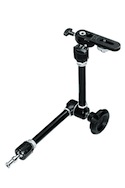
VL: This is a must have for any photographer or videographer. Period. I travel with one or two on EVERY shoot. You can mount a camera to just about anything - you can also mount microphones, monitors, and LitePanels with it too... basically when combined with a Super Clamp - you can clamp the Magic Arm pretty much anywhere. You will see the Magic Arm being used in combination with the Suction Cups in the video below. Description: Incorporates a large locking knob. Variable friction and locking of arm obtained by adjusting knob. Ideal for mounting a camera, light, gobo, etc, exactly at the angle you need it. 5/8" male studs on ball joints at both ends with 3/8" and 1/4-20" female thread. Works especially well with 2915 Super Clamp. Length: 20.8" |
||||
![]() |
![]() |
241FB 6" Suction Cup w/ Flat Base | B&H | Mfr. Site |
|---|---|---|---|---|
|
VL: If you want to mount a camera to a car or window - use two or three of these (for redundancy.) You can get away with 1 per bare camera - but I like to have a few just to be safe! Here is a video from the "Making of" Reverie - you can see how we used the Suction Cups in a variety of configurations throughout the shoot: Reverie - Behind The Scenes - 2008 from Vincent Laforet on Vimeo. Description (from Manfrotto): Suction cap for lightweight photographic and video equipment, such as 35 mm. SLR, digital cameras and lightweight video cameras. The 60mm diameter disc with a 3/8' male thread is built in the pump cup and enables you to mount most of Manfrotto's heads. |
||||
![]() |
![]() |
501HD Head | B&H | Mfr. Site |
|---|---|---|---|---|
|
VL: This is likely one of the best tripod heads to get started with. It's got a good friction control and at a fantastic price. Note that it doesn't have a bowl - ergo you can't adjust your horizon quickly... you'll have to do so by adjusting your still tripod legs which can be a real loss of time... something to keep in mind. For that reason alone my vote is for the 504HD head below. Description (from Manfrotto): Taking its inspiration from our top professional video head models, the 501HDV features a fixed counterbalance spring set for a typical weight of camera and accessories of 2.5kg that helps ensure both smoother tilt movements and greater equipment safety even when tilt locks are inadvertently left off. The easy-to-reach on/off switch allows the counterbalance system to be disengaged or re-engaged for different filming setups. With its improved design, the 501HDV head offers more ergonomics with locks and knobs that allow a more solid grip and better fingertip control. |
||||
![]() |
![]() |
504HD Head | B&H | Mfr. Site |
|---|---|---|---|---|
|
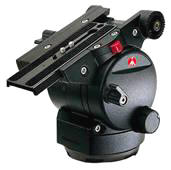
VL: This is THE head I would get if I was looking to start in video and was on a budget. It's pretty rock solid - you'll do fine w/ a basic HDDSLR kit on it - but don't expect to put a full cage w/ accessories or a long lens on it as it's not meant to support that type of weight... for that I'd go straight to the 526 head below. Description (from Manfrotto): The 504HD is Manfrotto's latest video fluid head. It is a perfect balance of design and performance. The bridge design improves the head's rigidity and its PAN friction control is fast, simple to fine-tune and protected from knocks. All structural components are made from aluminium, with the PAN axis rotation unit using ball bearings to obtain smooth, totally vibration-free controlled movements that can be directly adjusted using the head's FDS variable friction system. FDS on both the PAN and TILT axes also ensures that the head works perfectly at all temperatures, with all types of equipment and under all loads. Ergonomically improved lever and dial designs combine with the new friction index to give you complete control over the 504HD. |
||||
![]() |
![]() |
526 Fluid Video Head | B&H | Mfr. Site |
|---|---|---|---|---|
|
VL: This is the head I used for well over a year before I got turned onto the O'Connor 1030HD below. It's pretty rock solid and will support just about anything you throw at it in terms of weight... this is definitely a great long-term investment. No question. So why the O'Connor over this head? Basically you have a much more professional build on the O'Connor (granted at a much higher price point) - the main difference is the friction control, and the ability to switch directions seamlessly with the O'Connor mid-motion. You'll be able to do that with the 526 - but it's a bit more difficult, and the head may sometimes jerk a bit when you change pan/tilt directions RELATIVE to the O'Connor. When you work with an O'Connor it's hard to go back to anything else - because the head is so smooth that it makes your moves look like a veteran's moves.. This is basically the equivalent of a high end U.S. Automobile - vs a German engineered car (the O'Connor) although one is made by an Italian company and the other by a US Company - I hope the analogy works to explain the price difference... Point is: this is an EXCELLENT fluid head - just not as refined as the O'Connor. Description (from Manfrotto): The 526 Professional Fluid Video Head directly addresses the heavy-duty, high-end ENG and EFP video market by offering a feature-packed fluid video head that borrows all the combined benefits of our 500 series heads with the ability to support top weight loads over 15lbs. The 526 features a replaceable and removable pan arm rosette so if any damage occurs to the side castings, only a small part needs to be replaced; large rubber padded knobs for better grip and all the controls (tilt and pan lock, tilt drag) are located on the left side so they can be easily found. The 526 offers our most precise fluid drag system comprised of three step settings for low, medium and high drag levels (numbered 1, 2 and 3), plus the additional no-drag setting (number 0) for such occasions as snap-pans/tilts. Counterbalance is achieved through an adjustable spring for camera weights between 17.5 and 33 lbs. The built-in 4-inch half-ball adapts to a number of our tripods with a 4-inch receiver, allowing the quick leveling of the camera with the aid of the bright leveling bubble. |
||||
![]() |
![]() |
MPRO 536 Tripod | B&H | Mfr. Site |
|---|---|---|---|---|
|
VL: This is an excellent set of sticks - very fast to deploy and adjust. The advantage is that is can support a LOT of weight and has a great Max height. It is a non-standard video set of sticks - see below. I travel with this everywhere, as I use this both as my 2nd set of sticks w/ a fluid head - and to support sliders, JIBs and other equipment. Description (from Manfrotto): The new 536 video tripod is incredibly high and stable, has a great load capability and great max height with an ergonomic, easy-to-use and compact design. This lightweight tripod features a new leg angle selector, developed for adjusting the leg angle in a quick, easy and precise way. In addition, a screw-in 75/100mm adapter to hold the different industry standard half-ball heads. |
||||
![]() |
![]() |
546B Pro Video Tripod | B&H | Mfr. Site |
|---|---|---|---|---|
|
VL: This is the go to set of sticks for professionals who work with Manfrotto gear - reliable and versatile. Extremely fast to get in place and adjust. Description (from Manfrotto): Two-stage, extremely rigid, stable tripod. Able to carry loads up to 20kg (44lb). The 546B has a die cast aluminium crown with a built-in 75mm bowl. The tripod's telescopic mid-level spreader helps set leg angles accurately. Leg locks are secure and reliable, and spiked feet with rubber overshoes are provided for solid grounding on both uneven terrain and smooth floors.The tripod can be used with various dollies. |
||||
![]() |
![]() |
561BHDV-1 Monopod | B&H | Mfr. Site |
|---|---|---|---|---|
| VL: Description (from Manfrotto): The 561BHDV-1 is a compact but incredibly high 4-section aluminium fluid monopod. It is equipped with a fluid head (701HDV special version) including a new long sliding plate. The ergonomic pan bar allows smooth panning and tilting movements. | ||||
![]() |
![]() |
1030HD Fluid Head | B&H | Mfr. Site |
|---|---|---|---|---|
|
VL: Heavenly - but expensive relative to the heads above. I won't work with any other head - as O'Connor fluid heads are the industry standard for all motion pictures (this model and the larger models for heavier cameras.) The pan/tilt friction is unparalleled - as is the ability to perfectly balance a camera so that you can let go of it "in position" without having to lock the unit down is something to marvel at. Once you work with this fluid head you won't want to work with anything else. It's an investment for sure - but one piece of gear you'll use for the rest of your career. *NOTE: this piece of gear has been replaced by the updated 1030D (listed below). Description (from OConnor): Designed to give you the ultimate control and stability for your HD shooting. The 1030HD has the same features and controls as our 2575 fluid head, the standard for 35mm film cameras. Featuring OConnor's patented sinusoidal counterbalance system for true, accurate balance at any point in the tilt range. Add to this OConnor's stepless, ultra-smooth pan & tilt fluid drag specifically enhanced for HD applications, and you've got the best of all possible combinations. You can see the O'Connor Head in Action in the video below at the 7:05 Mark: 2010 HDDSLR Gear Video from Vincent Laforet on Vimeo. |
||||
![]() |
![]() |
1030HD Fluid Head | B&H | Mfr. Site |
|---|---|---|---|---|
|
VL: This is the updated version of the 1030HD listed above. I first got to try one out on the set of my short film, "Mobius." The head supports rigs up to 30 lbs., which we were close to maxing out with the fully built out C300 and Canon Cinema Zoom lenses. The 1030D's superior counterbalance system came in handy with these lenses as they are much larger and heavier than the C300 body. Description (from OConnor): An updated replacement of the popular Ultimate 1030HD and HDs, the new line offers a sporty industrial design and a slew of features that have been borrowed from the larger OConnors to let cinematographers seamlessly transition from heavier to lighter payload camera setups. These include the stepless, ultra-smooth pan and tilt fluid drag specifically enhanced to provide ultimate control and stability for digital cinematography shooting. The patented OConnor Sinusoidal Counterbalance system provides true, accurate balance at any point in the tilt range. Users will appreciate that the system Counterbalances down to zero, a handy advantage since there is a trend to lighter weight cameras. For today's versatile shooter, the transition from larger to smaller payloads has never been easier. And most importantly, the famous OConnor feel, remains the same regardless of payload. |
||||
![]() |
![]() |
25L Tripod Legs | B&H | Mfr. Site |
|---|---|---|---|---|
|
VL: A solid set of professional sticks that will carry just about anything HDDSLR related that you throw on it. Description (from OConnor): Lightweight Carbon Fiber, Two Stage Tripod, horizontal lever locks for quick, safe & secure leg adjustments. This lightweight tripod has a range of 15" to 66" while maintaining an extremely stable platform. |
||||
![]() |
VBag | VBag Camera Support Pad | B&H | Mfr. Site |
|---|---|---|---|---|
|
VL: This is a pretty ingenious solution for doing quick grab shots when you don't have time to use clamps or you don't have a baseplate handy. Description (from VBag): The VBag is made from high frequency welded, reinforced PVC-coated Polyester fibre sheets. Combining air tightness, with strength. It is developed on the basis of the manufacturers experience with the Swedish Air Force and paramedic products. By wriggling the camera into position the polystyrene pellets inside the V-Bag is forced to fit exactly around the base of the camera. When you evacuate the VBag it becomes rock hard and keeps its shape exactly unchanged. The reason for this transformation from soft to hard is the heavy force that the pressure differential between the empty inner side and the atmospheric outside act on the VBag. Also known as vacuum. |
||||
![]() |
RRS | B2 LLR II: 80mm LR clamp w/ dual mount | Mfr. Site | |
|---|---|---|---|---|
|
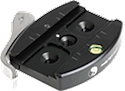
VL: This may be - the single best mounting system out there. I'm sure there are better high end solutions for the motion picture industry of course - actually I've used them. But I have to say that for still photography AND HDDSLR video (any video to be honest) this is the most elegant, perfectly engineered solution to quickly mount and unmount a camera to something else: either a tripod, a steadicam or pretty much anything else. As you'll see in the video below - it's an incredibly elegant way to quickly connect and disconnect two tripods to a slider in a second or so - with little hassle. Forget rotating that tripod or monopod for 15-30 seconds while you're missing the shot - these mounts clamp on SOLIDLY in a second. I obviously cannot be more of a fan of this product than I am. There is also a wonderful "L" bracket that allows you to go from horizontal to vertical move in seconds for still photographers. If you need to slide a camera a little bit forward or backward (or to the left or right) in an HDDSLR rig this is also a very good solution. Description (from Really Right Stuff): B2 LLR II is 80mm (3.15") long (lever adds add'l 5/8"), one central countersunk 3/8"-16 socket, two 1/4"-20 countersunk sockets 1.8" center-to-center, spirit level, safety stop relief grooves, and centering index marks, 5.9oz/168g Go to the 13:02 Mark on the video below to see the Really Right Stuff clamp and mount in action: 2010 HDDSLR Gear Video from Vincent Laforet on Vimeo. |
||||
![]() |
![]() |
theEvent | B&H | Mfr. Site |
|---|---|---|---|---|
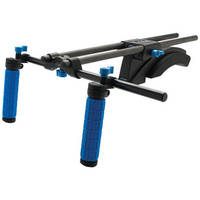
| Description (from Redrock Micro): Designed for extra stability while maintaining the freedom of handheld shooting, theEvent is designed with wedding/event and photojournalists in mind. theEvent sports two rugged handgrips and the microFinder loupe accessory, and adds our new microBrace body pad for and additional point of contact. Lightweight 6" carbon fiber rods keep the rig light and compact, and still allow enough room to add a microFollowFocus if desired. | ||||
![]() |
![]() |
eyeSpy | B&H | Mfr. Site |
|---|---|---|---|---|
| Description (from Redrock Micro): Sometimes the shoot requires a little more direct connection with the eyeball and camera. For a more traditional shouldermount shooting style we offer the EyeSpy rigs. EyeSpy starts with the shoulderpad, 18" 15mm carbon fiber rods, and single rubberized handgrip from the popular microShoulderMount. We've added an additional rod extension to center the camera for viewfinder use, and topped it off with the DSLR baseplate, and microFinder loupe accessory. You can also select versions that include the microFollowFocus v2 and the microBalance counterbalance weights for added stability and ease of use. | ||||


I thought you preferred the Steadicam brand stabilizer as opposed to the Glidecam? I got the impression from your CreativeLive workshop.
Reply
Vincent Laforet Reply:
September 9th, 2010 at 12:29 am
@art chong, I like both to be honest – and truth be told I use a wide variety of “steadicams” out there – usually operated by a skilled operator who has his/her preference.
Reply
Hi Vincent,
Can you elaborate a bit on the rig you used for the camera mount? In the video I see the following:
- 2 Manfrotto Magic Arms
- 3 Suction cups
My questions:
- Is the camera mounted on a Video Head?
- How do you attach the magic arms to the suction cups?
- And then to the camera in the middle?
- How can you vary the height of the camera? E.g. if you want to shoot from a somewhat higher angle on the hood of the car? Would you need a hi-hat for that?
Reply
Vincent Laforet Reply:
September 9th, 2010 at 12:30 am
@Richard van den Boogaard, Keep is a low key as possible – so no video head – use small Manfrotto still heads if possible. You will need to buy some different studs and clamps to make it all work – at some point I’ll detail it a bit more – but it’s complex. I’ll see if Mike Isler can chime in here with parts.
Reply
Richard van den .. Reply:
September 10th, 2010 at 8:57 am
@Vincent Laforet, thanks! That would be a great addition, as I find the dedicated systems for car mounts redicuously expensive… this way you can use those magic arms and clamps for other purposes as well.
Reply
Servo Stabilizer Reply:
May 23rd, 2012 at 3:29 am
The Servo Stabilizers uses an advanced electronic servo-motor concept to control a motorized variable transformer. Because of the motorization, there is a small delay in voltage correction. However, output voltage accuracy is usually ± 1% with input voltage changes up to ± 50%. These machines are not affected unduly by power factor or frequency variation. This type of technology tends to be extremely effective when considering large three phase applications, as it is able to maintain its accuracy of all three phases, both line to line and line to neutral, irrespective of input voltage balance and load balance at any power factor. They are also able to withstand large inrush currents, normally experienced with inductive loads. However due to the mechanics of this type of stabilizer, periodic maintenance is required.
Reply
Vincent I notice that you are holding a bag sort of weight to keep the camera steady in the shots of the Making of Reverie where the man takes the flower from the stand. Is that something you’ve rigger up yourself or that you have found?
Thanks!
Reply
Loved the Cineslider set up. You have the 536 listed as your tripod you use to support your set up. My question is this seems to only be for fluid heads, and in your videos the ones shown have a center column. is this a different tripod?
Always enjoy your posts man. look forward to your HDSLR rig blog.
Many thanks – @TheBraun
Reply
Hey Vincent,
Thanks for taking the time to answer our questions. Greatly appreciated.
For the Manfrotto 546B Pro Video Tripod, should I go for the Mid-level Spreader or Ground-Level Spreader. What is the difference?
Thank you!
Reply
Also, do I need a follow focus if I have a 5D, using Canon Lenses, like the 24-70mm, 70mm-200m or a 50mm?
Or would I just need to get a FF if I got Zeiss lenses?
Thanks!
Reply
i think sumthing’s wrong with this section vince
Reply
@Hunter Nolan, i too was wondering about that! If you have found anything on this, please post…
Reply
Are you using the Magic Arm at 2:36 on this video from CES http://vimeo.com/18622084?
Thanks!
Reply
Vincent Laforet Reply:
January 12th, 2011 at 10:02 pm
YES!
Reply
Hey Vincent,
How often do you use a steadicam device on your moving shots that are non-dolly/non-jib/non-crane/non-vehicle shots? When do you use the shoulder mounts? Ever use a fig rig?
Thanks!
Reply
Hi Vincent, a quick question I’m dying to know the answer to… The Red Bull Air Race picture with NYC in the background, was the camera attached using the manfrotto suction cup(s), or a custom hardware job? Would love to know!
Reply
Vincent,
what do you recommend? Merlin Steadycam or Glidecam?
I’m not considering the price, just its funcionality.
help me out on choosing!
Reply
Vincent – Wow! I cannot thank you enough for all of the help and information you put out there for upcoming filmmakers. So, so so helpful! Thank you!
I do mostly documentary and travel work and am looking at one of the simpler, more portable rigs from Red Rock or Cinevate, but the prices are blowing my mind! I have no problem investing in good gear and I can definitely afford one, but I just don’t really understand what I’m paying for! I keep telling myself I could easily make something just as effective – am I missing something here? Are these tiny setups really worth paying for?
Thanks man!
Reply
What plate are you using with the RRS clamp on the Cineslider?
Reply
@Vincent Laforet,
I use the glidecam and everyone gives me crap because it’s a low end model but when they see my footage they have no idea that is what I used. Hell, I don’t even have the X-10, just an overdeveloped right arm. When are DP’s going to figure out that the talent is in the person and not the equipment. Hell, I love using my napkins for diffusion when people ask for a photo in a restaurant. You should do a review on which napkins work best.
Reply
Hi!
Which Manfrotto tripod would you recommend to go with the Canon 5D Mark II?
I mean in terms of value and quality, what would you consider to be a good match?
Thanks in advance!
Btw, I admire your work!
Reply
Vincent Laforet Reply:
July 30th, 2011 at 11:21 am
Check out the gear section/ camera support section – I go into this in detail
Reply
Hi Vincent!
I am curious of what bottom plate do you use on your viewfactor cage with the RRS quick release?
Thanks!
Reply
Vincent Laforet Reply:
September 20th, 2011 at 3:18 pm
the really right stuff set
Reply
Hi Vincent,
I have the kessler cineslider, and its always a slightly clumsy effort putting it together. You used the RRS clamp and plate, but i couldn’t figure how you installed this onto the tripod. Could you explain this please. Much appreciated!
Reply
Vincent Laforet Reply:
September 27th, 2011 at 7:05 pm
Male plates from Really right stuff on both end – female on end of tripods for quick assembly and dissassembly… make sense? (also used to mount camera to head…)
Reply
Hello Vincent, i’m new to HDDSLR video, i’m a still photographer, so i own a 5D MkII, and a 24-70 2.8 + 85 1.8, i need stabilization to start, i don’t have anything (i don’t use tripod for my pictures) so i’m deciding.. i want to do wedding videos, everything is too fast, so i’m thinking to get the Monopod for video: Manfrotto 561BHD, but someone told me that i should start with a tripod, like 055XPROB + 501 head, what do you think?
I’m buying one of those as soon as possible, so i would like to hear your experience.
Thank you!
Gaston
Reply
Vincent Laforet Reply:
December 20th, 2011 at 12:00 am
You should try both. I HATE monopods – but some wedding photographs swear by them. They don’t have enough stability for me… I’d go w/ the Tripod+ good head – 504 from Manfrotto for around $1k – good luck! v (again: I don’t shoot weddings so keep that in mind…)
Reply
@Vincent Laforet, Thank you so much! I understand that you don’t do weddings, but if in your oppinion they don’t have enough stability, that’s a great point to have in mind.
Thanks again! Keep this kind of pages up to date, i know it take some work but a lot of people like me, want to know everything about what you do, and it’s great to have this online.
Reply
Hi Vincent,
Thanks so much for the insight you put into HDSLR shooting! When I use my 7d I experience some wobbling of the image. This is with panning and also with sudden moves. Would you know of a way to reduce these effects? I shoot mainly from a tripod but since I plan to do more documentary work with my camera on a shoulder rig I’m even figuring wether to use an HDSLR at all..
Hope you have some suggestions! Many thanks in advance!
Marnix
Reply
Vincent Laforet Reply:
January 11th, 2012 at 11:05 pm
That is one of the most difficult things to deal w/ the 7D… other than Warp Stabilizer in Adober After Effects- there is no software solution – just try to keep that camera as steady as possible (often by adding weight is the “easiest” way of accomplishing that.
Reply
Hi Mr. Laforet,
Your guide is an awesome resource for photographers/videographers. Thanks you so much! I was just wondering if you have seen or tried the Manfrotto 055 Magnesium Photo-Movie Head with Q5 Quick Release? I have been doing research and I think I will choose between the 504HD Head or the above mentioned. Reviews have been mixed and I just wanted to know if you heard anything about it. Thanks so much and keep up the great work. You are an inspiration to me.
Reply
Vincent Laforet Reply:
March 20th, 2012 at 10:09 am
I would stay away from that head unless you are using ONLY a 5D MKII (or similar) and small lens. It is not made to support a cine style rig if you will – too much weight… I would looks at the 504HD page – http://www.bhphotovideo.com/c/product/683563-REG/Manfrotto_504HD_546BK_504HD_Head_w_546B_2_Stage.html – which comes at around $700 and will serve you long term…
Reply
Hey Vincent,
I recently starting filming skateboarding videos and was wondering what you would recommend to use as a rig. I want a nice handheld rig that I can use with my fish eye shots and preferably something I can use down low while following people. I know you’re busy so thank you in advance and thank you for everything that you have contributed to the filmmaking community!
Reply
Vincent Laforet Reply:
May 8th, 2012 at 3:47 pm
Have you looked through the kits I put up on the gear page? For what you want to do you likely want a small cage with a top handle – follow focus etc are optional as you want lightweight… v
Reply
I have the Canon 60D with 17-55mm lens + a lightweight rig (jag 35 fieldrunner). I’m looking for a good tripod + head.
What would be the best investment: the 701HDV or the 501HDV? The 701HDV can support up to 4kg (my gear = 3,2kg), the 501HDV up to 6kg…
What would you recommend? 701 or 501?
Thanks a lot for your advice!
Reply
Vincent Laforet Reply:
May 19th, 2012 at 11:19 am
Going to put some new heads up soon – always go heavier than you need so you are “future proofed”
Reply
Vincent,
You have several aerial photos. I have never captured aerial footage besides through the window of a commercial plane. This is something I would love to do and may have a project coming up that requires it.
Can you provide some recommended gear for capturing aerial footage (video and photo)?
Also, can recommend any other steps in preparing for an aerial shot? Planning, logistics, paperwork, etc. I want to make sure I do this properly and legally.
Thank you.
Reply
Pheng Vue Reply:
May 15th, 2012 at 12:46 pm
Forgot to mention how great your blog is! Wish I found this sooner. Definitely love the gears page! =)
Reply
Hi Vincent,
just wondered what ball head you use for stills?
Cheers,
Dan Coffey
Reply
Vincent Laforet Reply:
May 19th, 2012 at 11:17 am
Really Right Stuff
Reply